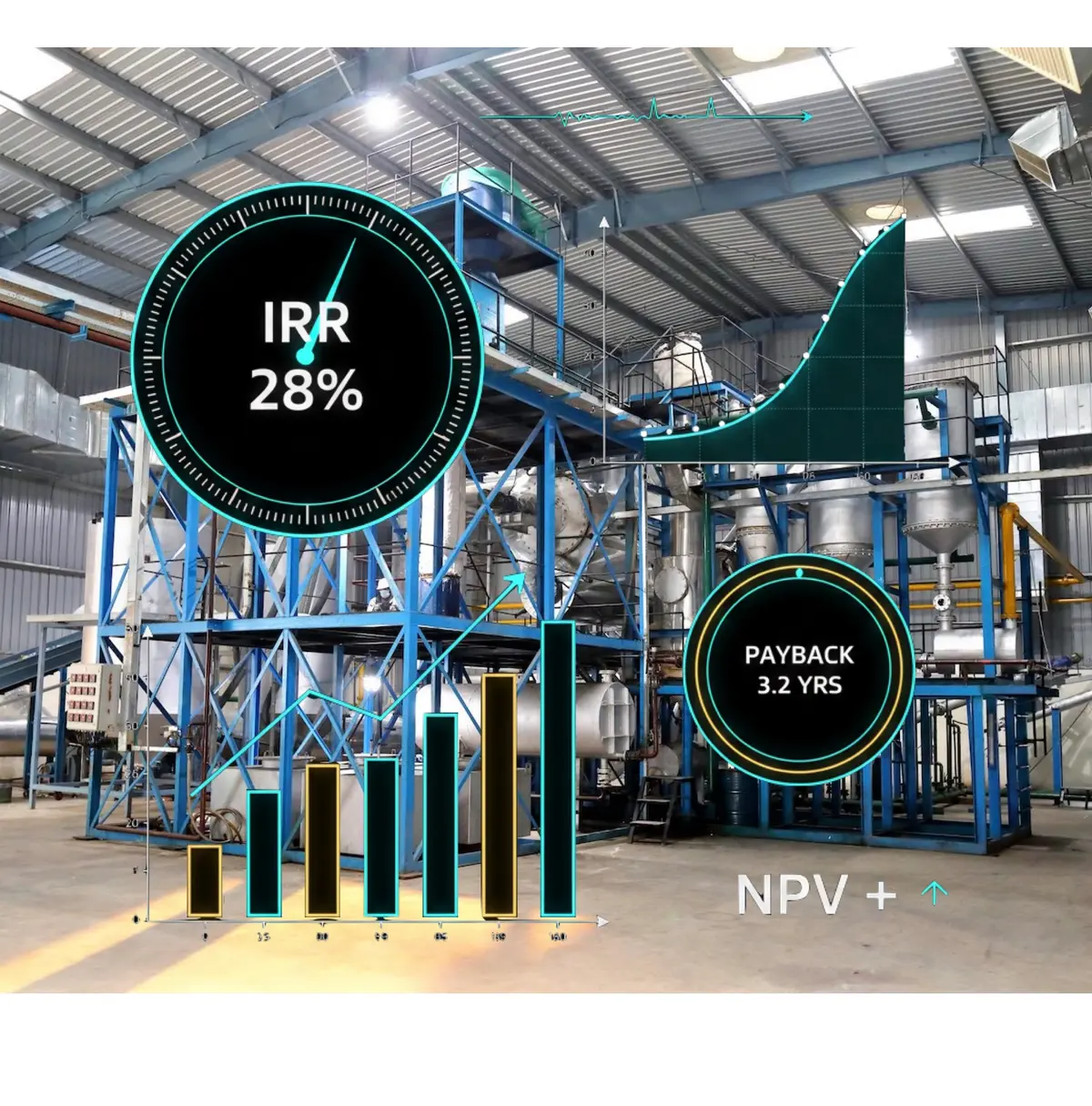
Tip: This calculator is currency-agnostic — enter values in your local currency. For the most accurate projections, test your specific feedstock with APChemi's R&D facility to get actual yield data.
Pyrolysis Plant Financial Model
Optimize Your Capital Investment & Maximize ROI — Currency Agnostic
Select Technology Type
Batch Pyrolysis Plant
- Lower capital cost
- 50-60% uptime
- 2-3 years plant life
- Suitable for small scale
Continuous Pyrolysis Plant
- Higher capital cost
- 85-92% uptime
- 8-20 years plant life
- Better for large scale
Plant Configuration
Feedstock & Products
Operating Expenses
Electricity + Rent + Insurance + etc.
Financing Terms
Key Performance Indicators
Annual Financials
Break-even Analysis
Sensitivity Analysis
Enter values to see sensitivity analysis
Optimization Insights
Enter plant parameters to see optimization insights
Understanding Pyrolysis Plant ROI
Pyrolysis plant ROI depends on the interplay between capital investment, operating costs, product yields, and market prices. Here are the key factors:
Product Yields
Oil yield varies 25-80% depending on feedstock. Higher yields = more revenue per tonne processed. Testing your actual feedstock is critical.
Market Prices
Fuel-grade pyrolysis oil: $300-500/t. ISCC-certified oil for chemical recycling: $600-1200/t. Certification can double your revenue.
Feedstock Costs
Many waste feedstocks come with gate fees (you get paid to take them). Negative feedstock cost dramatically improves ROI.
ISCC Certification
ISCC Plus certification enables selling oil at chemical-recycling premium ($600-1200/t vs $300-500/t). Often the single biggest ROI lever.
Carbon Credits
Biochar CDR credits ($50-200+/t CO2) can add 20-40% to biomass pyrolysis revenue. This market is growing rapidly.
Plant Efficiency
Continuous plants cost more upfront but have 20-30% lower operating costs per tonne vs batch. This accelerates payback for larger operations.
Typical Returns by Feedstock
| Feedstock | Oil Yield | Typical Revenue/t | Payback | 5-Year ROI |
|---|---|---|---|---|
| Mixed Plastics | 65-80% | $280-$640/t | 2-3 years | 150-300% |
| End-of-Life Tires | 40-50% | $250-$450/t | 2.5-4 years | 100-200% |
| Biomass (with CDR) | 20-30% | $200-$500/t | 3-5 years | 80-200% |
| Polystyrene | 75-85% | $320-$700/t | 1.5-3 years | 200-400% |
| Mixed Waste / RDF | 35-50% | $150-$300/t | 3-5+ years | 50-150% |
* Revenue per tonne includes all products (oil, char, steel, gas energy). Ranges depend on plant type, local markets, and certifications. Higher ranges assume ISCC certification and/or carbon credit revenue.
These are estimates based on industry averages. APChemi can test your actual feedstock and provide precise financial projections for your specific project.
How to Maximize Your ROI
Get ISCC Plus Certified
Biggest ImpactISCC certification can increase oil selling prices from $300-500/t to $600-1200/t. This single step can double your revenue and cut payback period in half. APChemi has 4 ISCC PLUS-certified plants (+1 coming up), including its own.
Test Your Feedstock First
Don't rely on generic yield data. APChemi's R&D facility tests your specific waste to determine actual yields, optimal temperature, and product quality. This $2K-$15K investment prevents $100K+ in plant design mistakes.
Secure Gate Fee Feedstock
Negotiate contracts with waste generators who pay you to take their waste (gate fees of $20-$100/t). This creates a revenue stream from Day 1 and reduces feedstock procurement costs.
Add Oil Purification
Fractional distillation of crude pyrolysis oil separates it into diesel, light oil, and heavy fractions — each commanding higher prices than crude oil. APChemi operates its own 15,000 L/day distillation plant.
Choose Continuous Over Batch
Continuous plants have higher upfront costs but 20-30% lower operating costs per tonne, higher throughput, and better product consistency. For capacities above 5 TPD, continuous almost always wins on ROI.
Powered by APChemi — Data-Driven Pyrolysis Engineering
Frequently Asked Questions
This calculator provides preliminary estimates based on industry-average data. Actual ROI depends on your specific feedstock, local market prices, regulatory environment, and plant design. For a precise feasibility assessment, APChemi conducts feedstock testing and detailed techno-economic analysis tailored to your project. The calculator is designed to give you a realistic starting point for planning.
Mixed plastics (HDPE, LDPE, PP) typically offer the highest ROI due to 65-80% oil yields and relatively low feedstock costs. Tire pyrolysis is also attractive with 40-50% oil plus valuable recovered carbon black (rCB) and steel. Biomass pyrolysis ROI depends heavily on biochar carbon credit revenue — with CDR credits at $100+/tonne CO2, biochar projects can achieve excellent returns.
Operating costs typically range from 40-60% of revenue: feedstock procurement (0-15% — many waste feedstocks come with gate fees), energy (10-20%), labor (10-15%), maintenance (5-10%), and consumables/overheads (5-10%). Continuous plants generally have lower per-tonne operating costs than batch plants due to better energy efficiency and lower labor requirements.
Typical payback periods range from 2-5 years depending on plant type, feedstock, and market conditions. Factors that shorten payback: gate fee income (getting paid to take waste), carbon credit revenue, ISCC certification premium on products, and government incentives. Continuous plants tend to have faster payback than batch due to higher throughput and lower operating costs.
Yes — the calculator includes an optional carbon credit revenue input for biochar-producing plants. Carbon removal credits for biochar are currently valued at $50-$200+ per tonne CO2 on voluntary markets. This can significantly improve ROI for biomass pyrolysis projects, often reducing payback by 1-2 years.
Get a Free Consultation
Tell us about your pyrolysis project and our engineers will get back to you within 24 hours.
Get a Free Project Assessment →Explore More
Pyrolysis Plant Cost Guide
Detailed breakdown of pyrolysis plant capital and operating costs.
Feasibility Study Guide
Complete guide to evaluating a pyrolysis project's viability.
Business Plan Guide
Structure a bankable pyrolysis business plan for investors.
Biomass Pyrolysis Plant
Biochar production with CDR carbon credit potential.
R&D / Lab Testing
Test your feedstock to get actual yield data for accurate ROI.
Contact APChemi
Get a detailed feasibility assessment from APChemi's engineers.